Ultrasonic Testing
- Created By admin@decibel
- Last Updated November 4th, 2021
Ultrasonic Testing (UT)
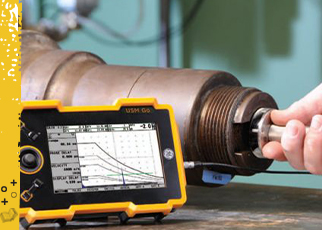
This method employs high frequency sound pulses that are emitted from a transducer; this sound wave is induced in to the material through a probe which is usually in contact with the material. These sound waves propagate through the material, and are reflected back to the probe when they reach an interface. The reflected waves are transmitted back through the probe and connecting leads to a detector which can be either analogue or digital. The sounds waves are then displayed as a series of signals on a monitor and the qualified inspector can measure, and interpret these signals to allow accurate evaluation of the internal structure of the material.
Ultrasonic testing can not only be used to indicate a surface or subsurface flaw it can also be used to determine the depth, size and type of flaw. Another advantage of using UT is the accurate measurement of the thickness of the material. The method can be applied to most materials providing the material can transmit sound waves. UT is considered to be a fast and effective way of inspection providing high sensitive results.
PCN & SNT-TC-1A minimum work experience and training hour’s requirements for UT examinations
Level 1
- 40 hours Training (PCN & SNT-TC-1A)
- 3 months Work Experience (PCN), 210 hours work experience in method and 400 hours work experience in NDT(SNT-TC-1A)
Level 2
80 hours Training (additional to the 40 hours for Level 1) (PCN), 40 hours Training (additional to the 40 hours for Level 1) (SNT-TC-1A)
3 months Work Experience (additional to the 3 month for Level 1) (PCN), 630 hours work experience in method and 1200 hours work experience in NDT (additional to the Level requirements) (SNT-TC-1A)
If a candidate wishes to go direct to Level 2 without first taking the Level 1route, the minimum requirements are the total accumulative requirements of both Level 1 and 2.
We can provide Ultrasonic training courses and examinations suitable for any of the following certification scheme.
- SNT-TC-1A in accordance with your/our company written practice We can also provide
- Preparation training for ASNT Level 3
An example of the syllabus that is used for ultrasonic examination training courses is shown below for level 1 and 2. DECIBEL can tailor make the syllabus to satisfy the requirements of an individual’s company specific written practice if requested.
In the PCN certification scheme Ultrasonic Testing is separated into three specific product sectors for certification purposes, these are
- Welds
- Wrought Products (Forgings)
- Castings
The welds sector is further sub divided into groups, these are
- Plate Butt Welds
- Pipe Butt Welds
- Constructional “T” Joint
- Nozzles
- Nodes
| Level 1 | ||
|---|---|---|
| General Theory | Specific Theory | Practical Examination |
|
|
Follow written instructions and process the inspection test pieces, record and report defects from know datum markers, carry out pre test calibration checks, post test procedures. |
| Level 2 | ||
|---|---|---|
| General Theory | Specific Theory | Practical Examination |
|
|
Production of written instruction, determine the best inspection techniques for the individual parts, process the inspection test pieces, record and report defects from know Datum markers, carry out pre test calibration checks, post test procedures. |
About Qualification
Level 1 General Qualification required for separate certification:
10th Grade, SSLC, +2, HSC, Diploma – above or equivalent.
Level 2 Direct – General Qualification required for separate certification:
Level 1 With 6 month’s industrial experience or Science Graduation, Engineering Graduation.
Course Duration:
Will vary depends on the type of certification chosen